There’s a particular kind of anxiety that comes with watching a tracking page refresh and tell you nothing new.
I think most people who’ve shipped something meaningful across an ocean know the feeling. A car. A container of stock your business is depending on. The contents of a house you’ve spent a decade filling. It leaves your hands at one port, and then there’s a stretch of time — sometimes weeks — where it exists only as a reference number and a vague promise.
That gap is where shipping either works or doesn’t. And having watched a lot of freight move badly, I’ve become quietly convinced that the difference between a smooth international shipment and a nightmare has almost nothing to do with the ships themselves. It’s about who’s steering.
Which brings me to the thing I actually want to write about: what Compass Shipping does differently, and why an independent Irish freight forwarder with 25 years behind it tends to get cargo where it’s going when bigger names don’t.
The problem with big logistics
Here’s the uncomfortable structural truth about global freight. The largest logistics companies are extraordinary at volume and mediocre at exceptions.
If your shipment is standard — palletized, containerized, well-documented, going to a major port on a major lane — the giants handle it fine. Their systems are built for exactly that. But international shipping is a business made almost entirely of exceptions. A machine that’s four inches too wide for a standard container. A customs officer in a destination country who wants a document nobody mentioned. A vessel that gets rescheduled and cascades a delay through three connecting legs. A car with personal belongings packed inside it is a completely different customs proposition than an empty car.
Exceptions need a human who knows your file, has the authority to resolve issues, and can pick up the phone. In a large organization, that person is either unreachable or doesn’t exist.
This is where a smaller, independent freight forwarder has a structural advantage rather than just a sentimental one. Compass Maritime is Irish-owned and independent, which means the person managing your shipment can actually make decisions about it.
Position matters more than people realize
Compass Maritime operates from Santry, Dublin 9 — sitting between Dublin Port and Dublin Airport.
That sounds like a trivia detail. It isn’t.
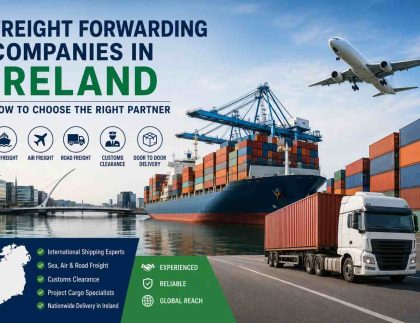
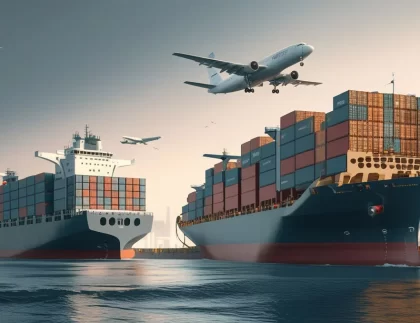
Freight forwarding is fundamentally about mode flexibility. The ocean is cheap and slow. Air is fast and expensive. Road handles the first and last miles and everything within Europe. The forwarders who consistently deliver are the ones who can switch between these when circumstances change — bump an urgent component to air freight when a vessel slips, consolidate slower-moving stock into ocean freight, and arrange the haulage that connects both to an actual address.
Being physically positioned between a major deepwater port and an international airport isn’t a coincidence of real estate. It’s operational architecture. It means ocean freight, air freight, and road transport are all genuinely available options rather than services subcontracted to someone three steps removed from your shipment.
Ireland’s own position adds to this. As an island economy on the western edge of Europe, Irish freight has always had to be good at multimodal movement — nothing arrives or leaves without crossing water. And post-Brexit, Irish forwarders acquired a level of customs fluency that operators in less complicated jurisdictions simply haven’t needed to develop.
The four things that actually go wrong
After enough conversations about shipments gone sideways, the failures cluster into a short list. It’s worth knowing what they are, because they’re what a good forwarder is quietly preventing.
Documentation. This is the big one, and it’s boring, which is why it’s the big one. Bills of lading, commercial invoices, certificates of origin, packing lists, dangerous goods declarations. Get one wrong, and your cargo sits in a bonded warehouse accruing storage charges while someone tries to reach someone. Customs clearance handled by people who do it every day is not a luxury service — it’s what prevents your goods from becoming very expensive furniture at a port.
Wrong-sized solutions. Cargo that doesn’t fit standard dimensions—such as construction plant, agricultural machinery, and industrial equipment—requires out-of-gauge and project cargo handling. That’s flat racks, open tops, breakbulk, lifting plans, route surveys. Booking that as if it were standard containerized freight is how you find out at the port that it can’t be loaded.
Handoff gaps. International shipments involve many parties: the origin hauler, the port, the carrier, the destination port, the customs broker, and the final delivery. Every handoff is a place where responsibility can quietly evaporate. A forwarder’s real job is to own the whole chain, so there’s no seam where your cargo becomes nobody’s problem.
Information blackout. This one is emotional rather than operational, but it’s real. Not knowing is genuinely stressful, and end-to-end tracking and monitoring isn’t about surveillance — it’s about not spending three weeks wondering.
What “on course” actually means in practice
The compass metaphor is right there in the name, and it’s more apt than most brand metaphors.
A compass doesn’t move the ship. It doesn’t make the journey shorter or the weather better. What it does is tell you where you are relative to where you’re going, continuously, so that when you drift — and you always drift — you correct early rather than discovering the problem at arrival.
That’s what good freight forwarding is. Not the absence of problems, because international shipping across dozens of jurisdictions will always generate problems. It’s the continuous small corrections. Flagging that a document will be needed before it becomes urgent. Noticing a schedule change and rebooking the onward haulage. Knowing that a particular destination has a particular quirk because you’ve sent freight there fifty times.
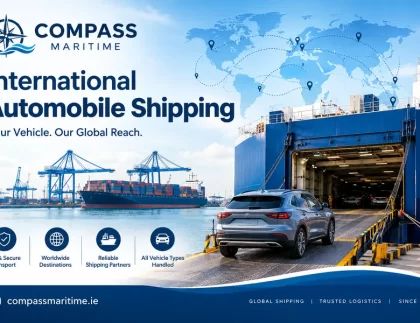
Across the range of services Compass Maritime handles — container shipping, car and vehicle shipping, plant and machinery, project cargo, household and personal effects, and commercial freight to worldwide destinations — the mechanism is the same. Someone is watching, and someone corrects.
Who does this actually matter for
Businesses importing or exporting. Your supply chain is a promise you’ve made to your own customers. Freight delays don’t stay in the freight department; they land in customer service.
People shipping vehicles. Cars moving internationally — a classic being restored, a vehicle following an owner who’s relocated, an imported machine — involve a documentation and handling profile that general couriers simply aren’t set up for. Vehicle shipping is a specialism.
Anyone relocating internationally. Household shipping carries an emotional weight that commercial freight doesn’t. It’s not stock; it’s your things. That deserves to be handled by someone who treats it accordingly.
Industrial and construction operators. Plant machinery and out-of-gauge cargo need planning that starts long before the loading date.
The unglamorous conclusion
I’ll be honest, freight forwarding is not an exciting subject. Nobody grows up dreaming about bills of lading.
But there’s something I find genuinely appealing about businesses whose entire value is that things go right and you never find out how close they came to going wrong. Twenty-five years of doing this is twenty-five years of accumulated knowledge about which routes are reliable, which paperwork trips people up, which destinations need extra lead time — knowledge you can’t shortcut and can’t buy.
When your cargo leaves your hands, you’re trusting a system you can’t see. Compass shipping is built on the fairly simple premise that there should be a person inside that system who knows your name and your shipment.
That’s it. That’s the whole thing. It just turns out to be surprisingly rare.
Shipping something internationally, in or out of Ireland? Compass Maritime handles ocean, air, and road freight to destinations worldwide — from single vehicles to full project cargo. Worth a conversation before you book.